The history of i18next, from 2011 to version 27
On this page
i18next began in December 2011 as a translation library for single-page apps. The decisions taken since still shape how it works today: one core for every environment, plugins for everything around it, and code for version 1 that still runs with a layer.
The first commit to i18next is from and is called "initial version". Almost fifteen years and 27 major versions later, this is how it got from there to version 27.
How it began, in 2011
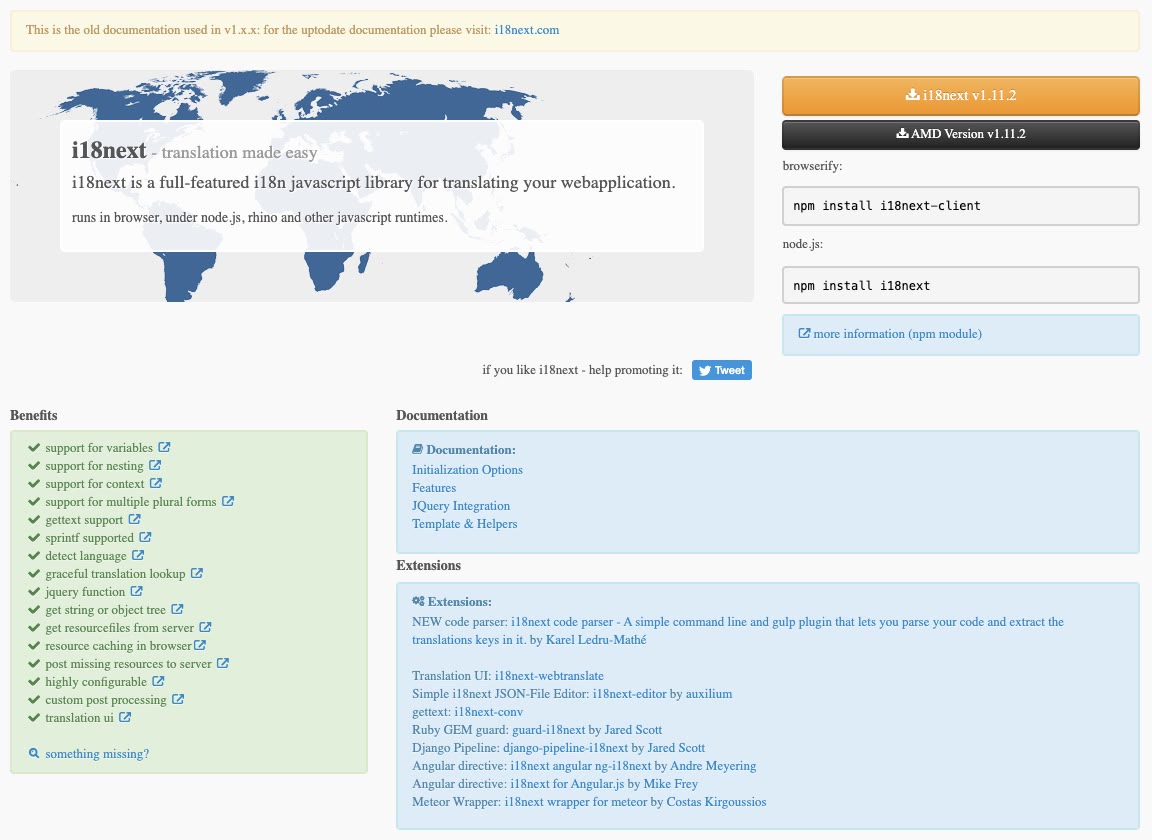
Jan Mühlemann wrote i18next as an internationalization library for single-page applications in the browser. It reached 1.0 ten days after the first commit, on . On npm, the name i18next belonged to its companion for Node.js from on: i18next-node, a middleware for Express. The browser library came to npm only in 2014, as i18next-client. By its last release, version 1 ran in the browser, in Node.js and in Rhino, with variables, nesting, context, plurals and a jQuery function.
Version 2, rebuilt around plugins, 2015
On we released version 2, a rewrite and the first i18next on npm built from the browser library's repository: one library for the browser and for Node.js. Loading translations, detecting the language, caching and post-processing come from plugins, and the core stays the same in every environment. The language detector for the browser had come out six weeks before, on . react-i18next came out the same day as version 2.
Code for version 1 still runs, with a layer
Up to version 23 the core still had an option for the old API, compatibilityAPI: 'v1'; version 24 removed it. What
remains is a compatibility layer in i18next's repository, not in the npm package:
test/compatibility. It turns version 1's options
and calls into today's (v1/v1.js, 151 lines, and v1/v1.i18nInstance.js, 111 lines) and reads the old plural format
that the core no longer reads itself (v4/v4Compatibility.js with its helpers, 488 lines).
The tests of version 1.11.1 run against every release through this layer, together with i18next-http-backend,
i18next-localstorage-cache, the browser language detector and the sprintf post-processor. On i18next 27.2.3, 302 of
the compatibility tests pass and 7 are skipped, because the layer does not cover them: synchronous loading, the global
i18n variable, indefinite articles and one nested value. An app still written for version 1 copies the layer into its
own code.
The milestones
After version 2 came 25 more major versions. A major version of i18next is any release that can break existing code, sometimes for a single option.
| Date | Milestone |
|---|---|
| The first commit, a library for the browser | |
| i18next on npm, then the Node.js module (i18next-node) | |
| The browser library on npm, as i18next-client | |
| i18next-browser-languagedetector | |
| Version 2: one i18next for the browser and Node.js, built around plugins; the first react-i18next | |
| next-i18next, started by Isaac Hinman | |
| i18next-http-backend | |
Version 24: the old JSON formats and compatibilityAPI removed, the Intl API required |
|
| i18next-cli: extract the keys, check translations in CI, write the types | |
| next-i18next 16, with the App Router | |
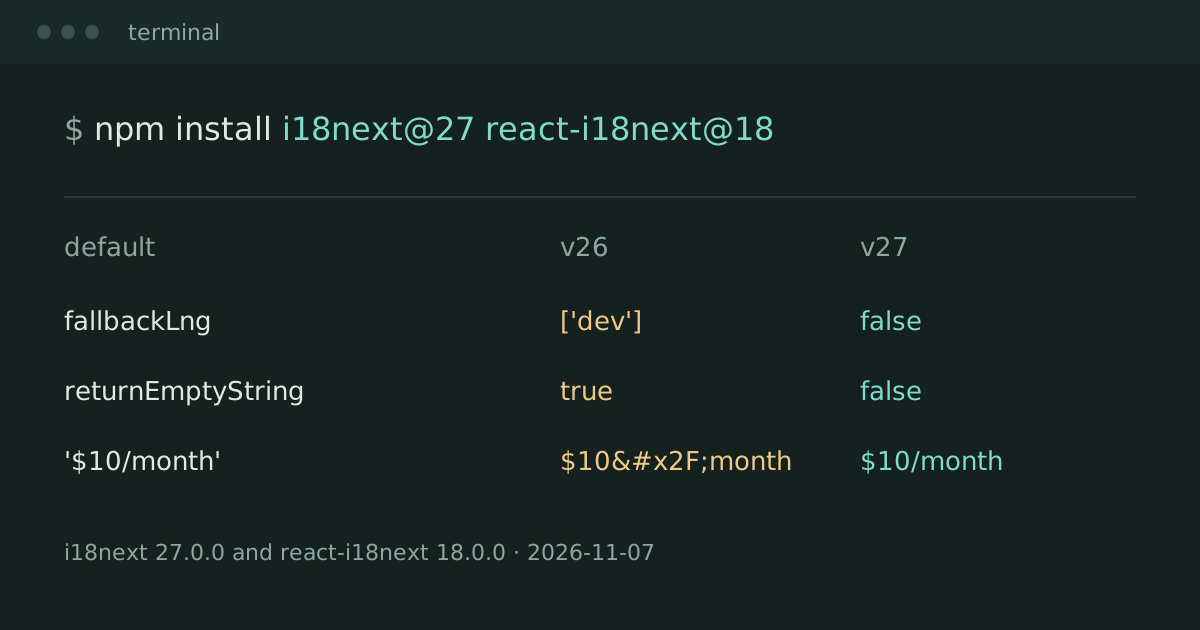
| i18next 27 and react-i18next 18 |
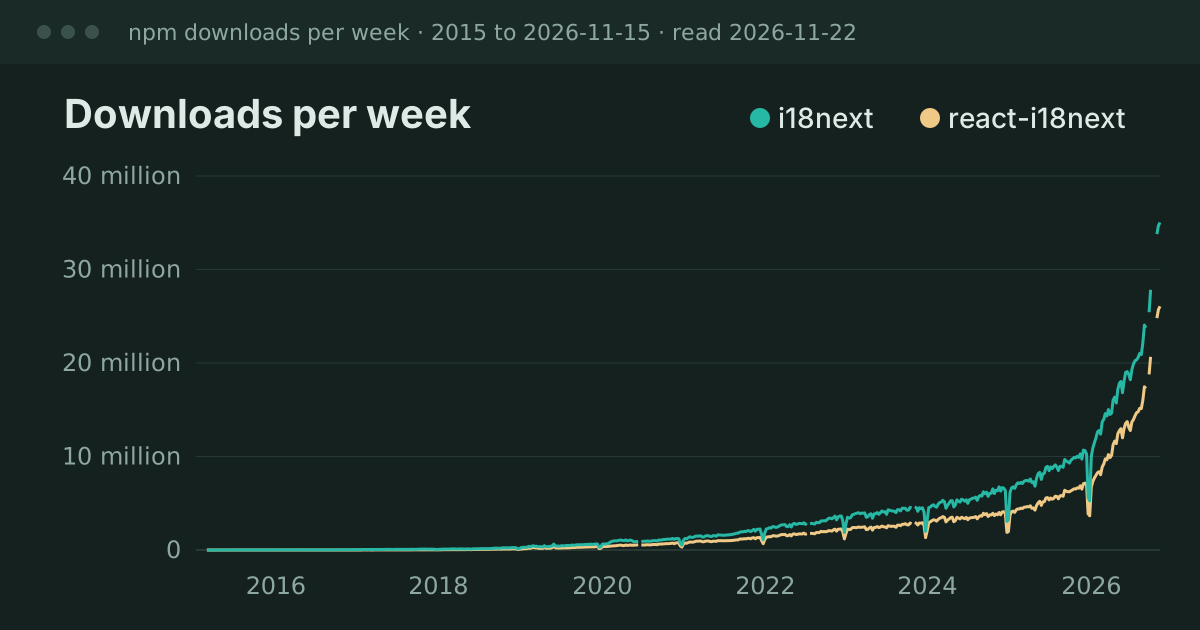
The downloads
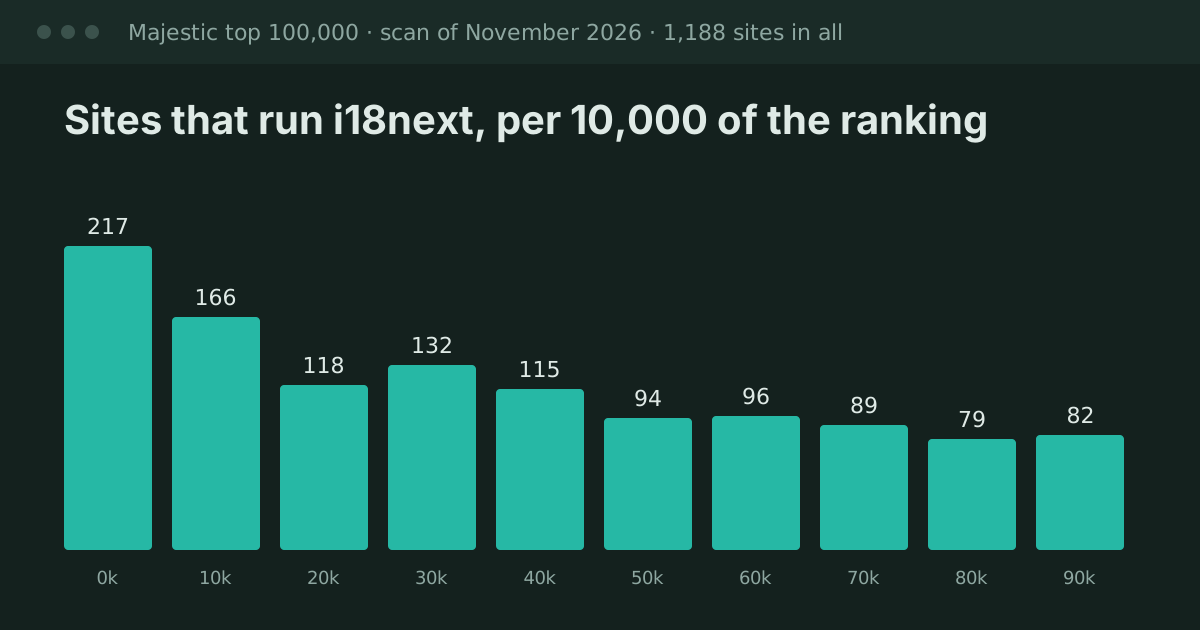
Until the line of i18next counts i18next-node, the Node.js module that held the name on npm; from version 2 on, the one library. How many websites run it: Who uses i18next.
Who maintains it
Jan and Adriano maintain i18next together. Locize is our translation management service, and its customers fund the work on i18next.